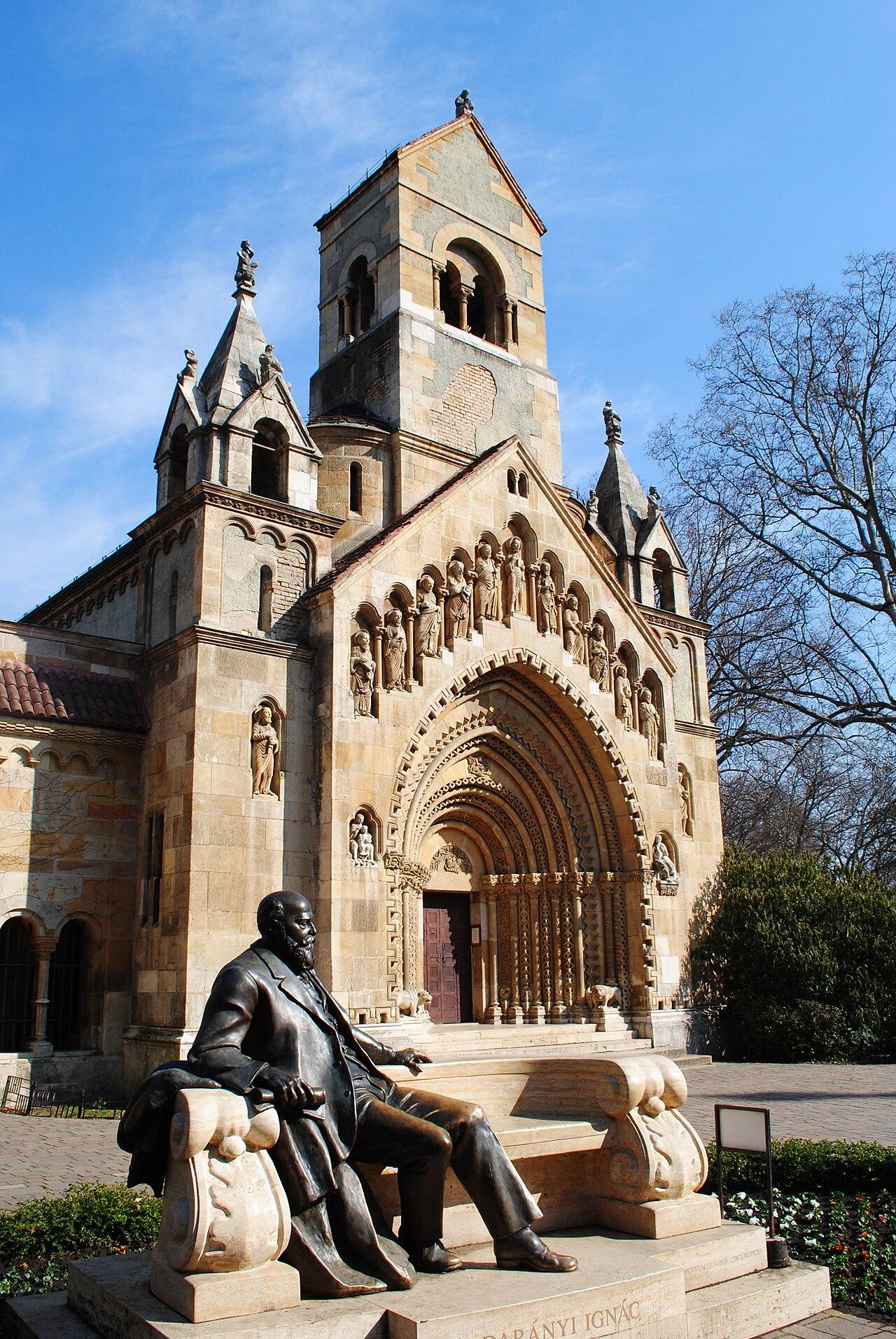
Two hundred kilometres further west, in the village of , stands an abbey church from 1256, and its entrance has been copied here stone by stone. That gives the little church against the castle wall the look of a Romanesque village church. Above the door, a semicircular panel bears the Lamb of God, and above that stands Christ, flanked by five apostles in niches on either side.
The rest of the building comes from elsewhere. The tower was borrowed by from the Chapel of Saint Michael in , today's Košice in Slovakia, and the floor plan follows that of the village church of Lébény. So what you're looking at is a single church assembled from three.
Stranger still is what it was meant for, because it was never supposed to become a church at all. The building was conceived as the library of the museum, and only when local believers asked for it did it take on a religious role: in 1915 Bishop Kohl Medárd consecrated it to . Twenty-three years later two Italian cardinals who would both become pope said mass together here, Eugenio Pacelli as Pius XII and Giovanni Battista Montini as Paul VI.
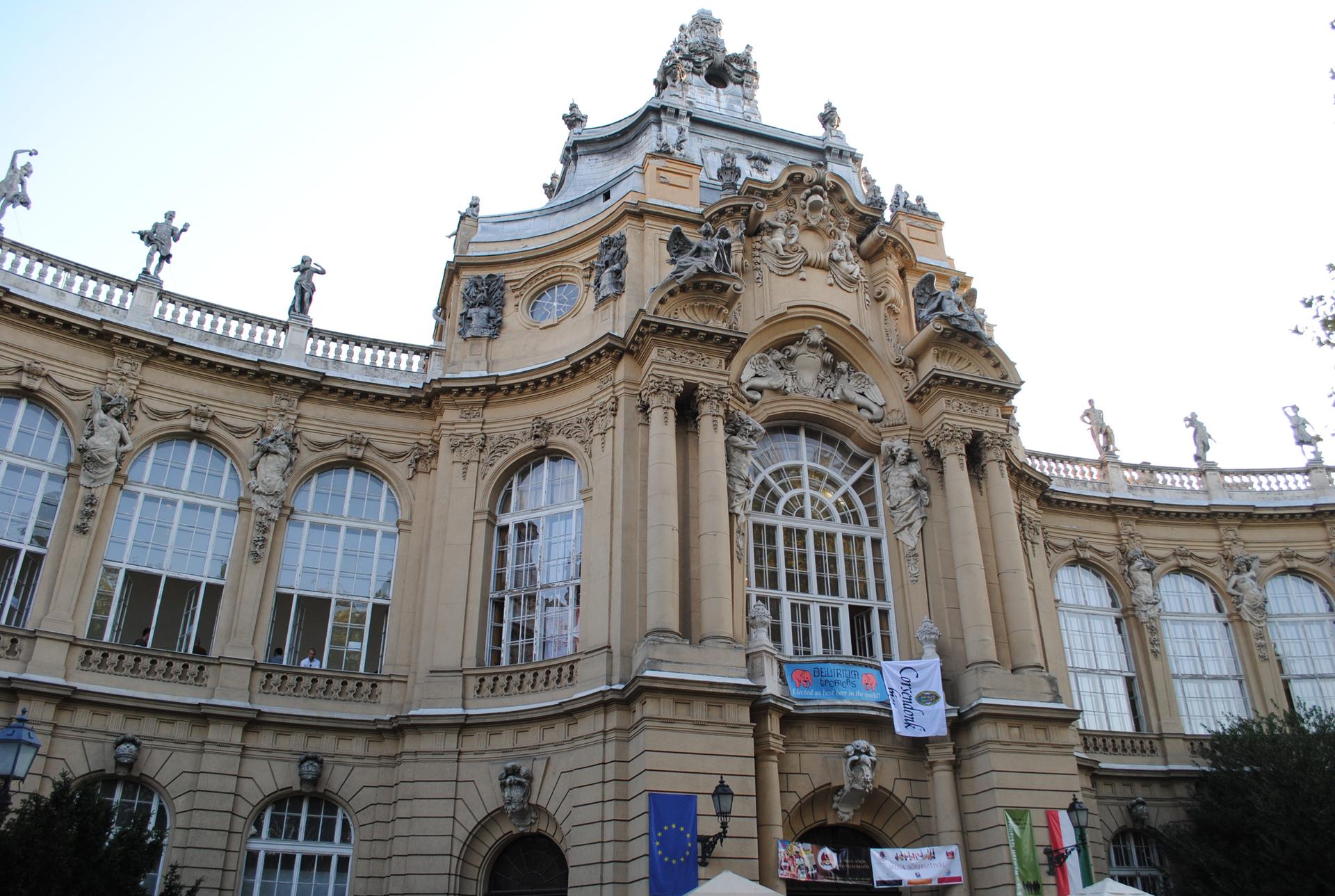
We cross the courtyard to the southern wing, where the wide entrance to the museum lies.
Sources. Story: jakikapolna.hu, the chapel's own site, for the doorway modelled on Ják, the tower on the Chapel of Saint Michael in Kassa, the floor plan on Lébény, the library purpose, the consecration by Kohl Medárd in 1915 and the 1938 mass; Esztergom-Budapesti Főegyházmegye on the transfer to religious use; hu.wikipedia on the building history of the Romanesque section Photos: Marek Mróz, CC BY-SA 4.0, via Wikimedia Commons