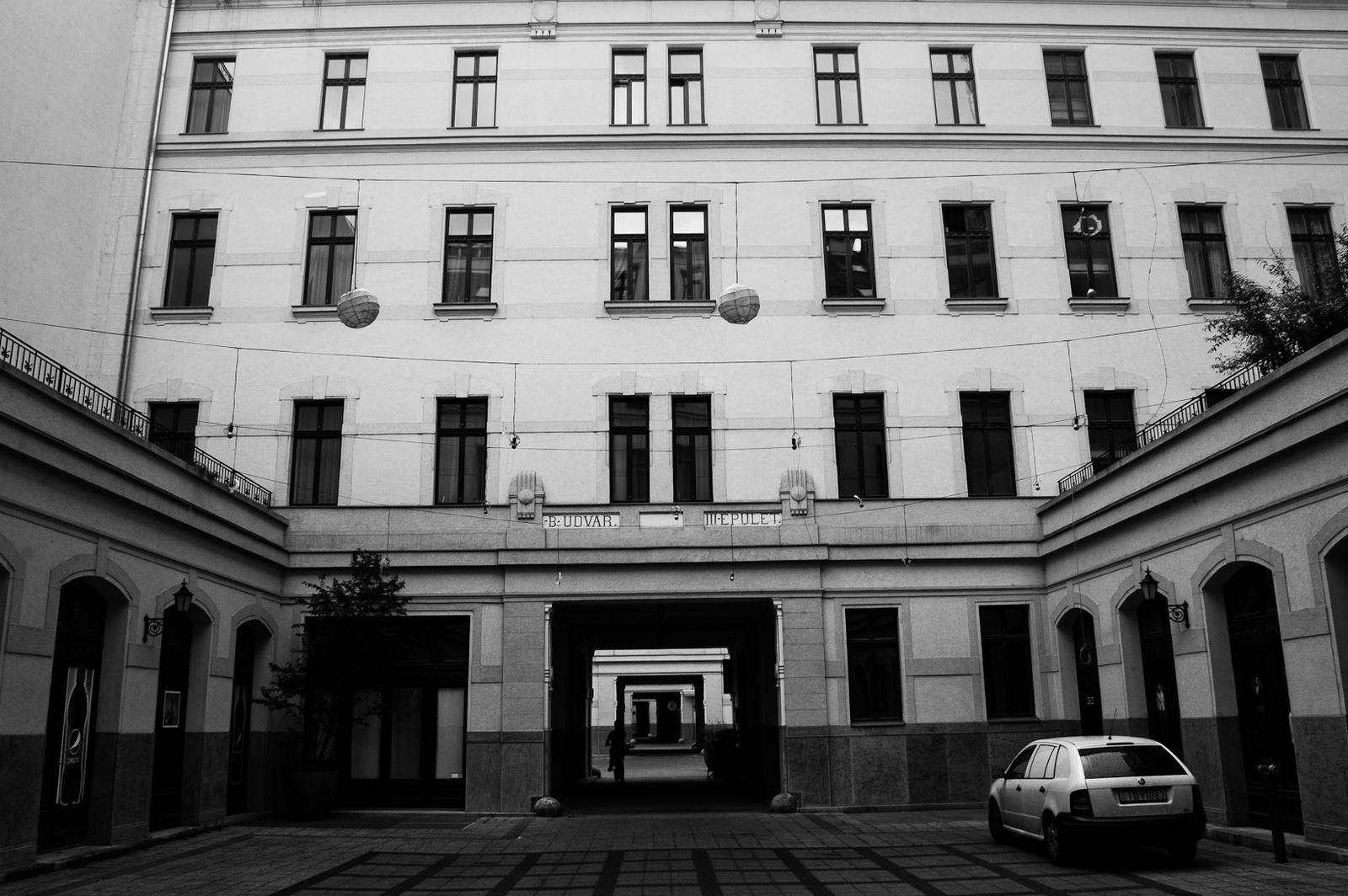
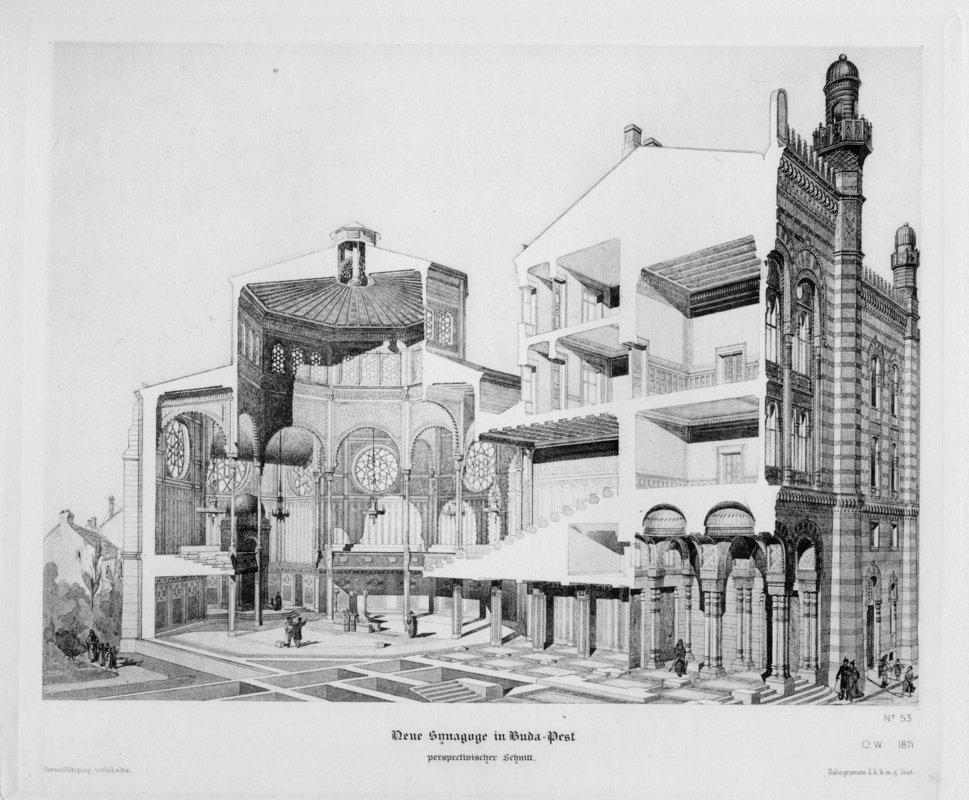
This walk passes three synagogues, and this is the one you'd have missed without a nudge. From the street you see a facade with two towers that look like minarets, and behind it an ordinary townhouse that once held the classrooms and the rabbi's home. The hall itself hides away behind all that, tucked deep inside the city block.
The community split into three directions in 1868. The got the great synagogue on , the Orthodox stayed for the time being in the Orczy-ház where you were standing a moment ago, and the third group wanted everything to stay exactly as it had always been. That's why they were called the , and between 1869 and 1872 they built their own home right here.
The commission went to a twenty-six-year-old Viennese who had barely built anything yet, , later one of the founders of the movement. He had trained under , the architect of the Dohány synagogue, and he never once came to Budapest for this job. His colleague Kallina Mór ran the construction. What Wagner drew is an octagonal hall beneath a high dome, carried by eight slender iron columns with capitals modelled on the Alhambra.
The building was damaged in the war and then stood empty for almost sixty years. A restoration in the 1980s stalled halfway, right at the level of the gallery. Only in 2021 did the hall open again. We're walking now into Király utca, where a stretch of the old ghetto wall still sits inside a gateway.
Sources. Story: Kultúra.hu, over de Rumbach-synagoge en de status quo ante-gemeente; Pestbuda, over Otto Wagner als leerling van Ludwig Förster en over de restauratie; Mai Magyar Építészet, over het voorhuis en de reconstructie van de zaal. Photos: Cross-section drawing: Otto Wagner, 1871, public domain, via Wikimedia Commons. Interior: Derbrauni, CC BY 4.0, via Wikimedia Commons.