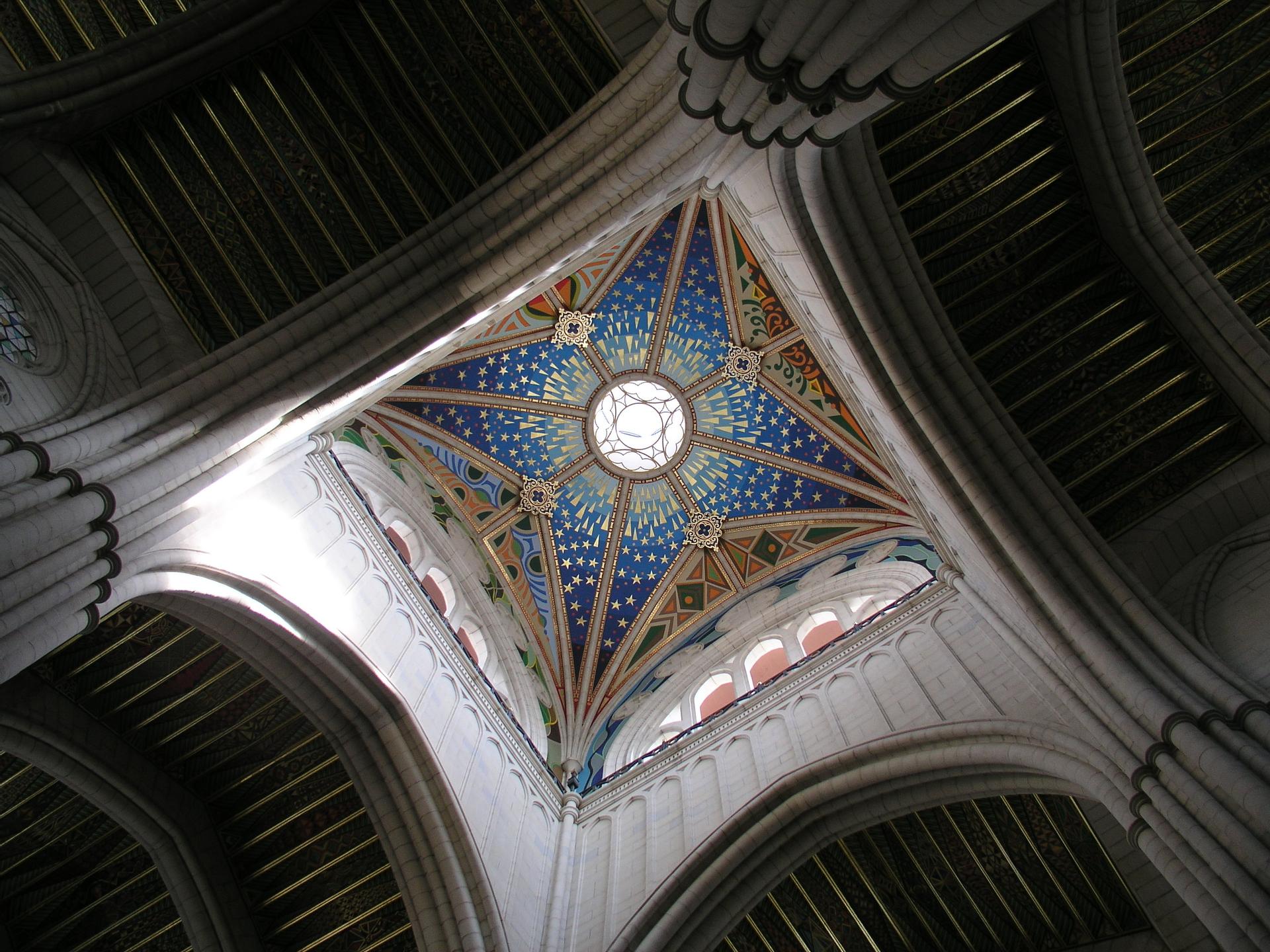
If you step inside with an image of grey vaulting and stained-glass gloom in your head, you'll find something else entirely. The ceiling above the nave is painted in bold panels of red, blue, green and gold, a twentieth-century geometric pattern that feels closer to textile than to a church. The icons around the high altar come from , a painter who also founded a Catholic movement, and he worked in a you'll rarely come across anywhere else in Spain.
There's something else peculiar about this space, though you'll only notice it if you pay attention to which way you're facing. Most churches run east to west, with the altar towards the rising sun. This one runs north to south, because the building had to fit into complex, and so the king won out over tradition.
Beneath the church lies a crypt from the early twentieth century, with hundreds of columns, no two of which share the same capital. It's also home to the late-medieval statue of the , which, so the legend goes, spent centuries sealed inside the city wall, and here too rests for whom all of this once began.
Outside, we cross the square towards the palace gate, where the courtyard opens up before us.
Sources. Story: Catedral de la Almudena, Archidiócesis de Madrid; esMadrid, Ayuntamiento de Madrid. Photos: Photo of the painted vault: Håkan Svensson (Xauxa), CC BY-SA 3.0 via Wikimedia Commons. Photo of the crypt: Simon Burchell, CC BY-SA 4.0 via Wikimedia Commons.